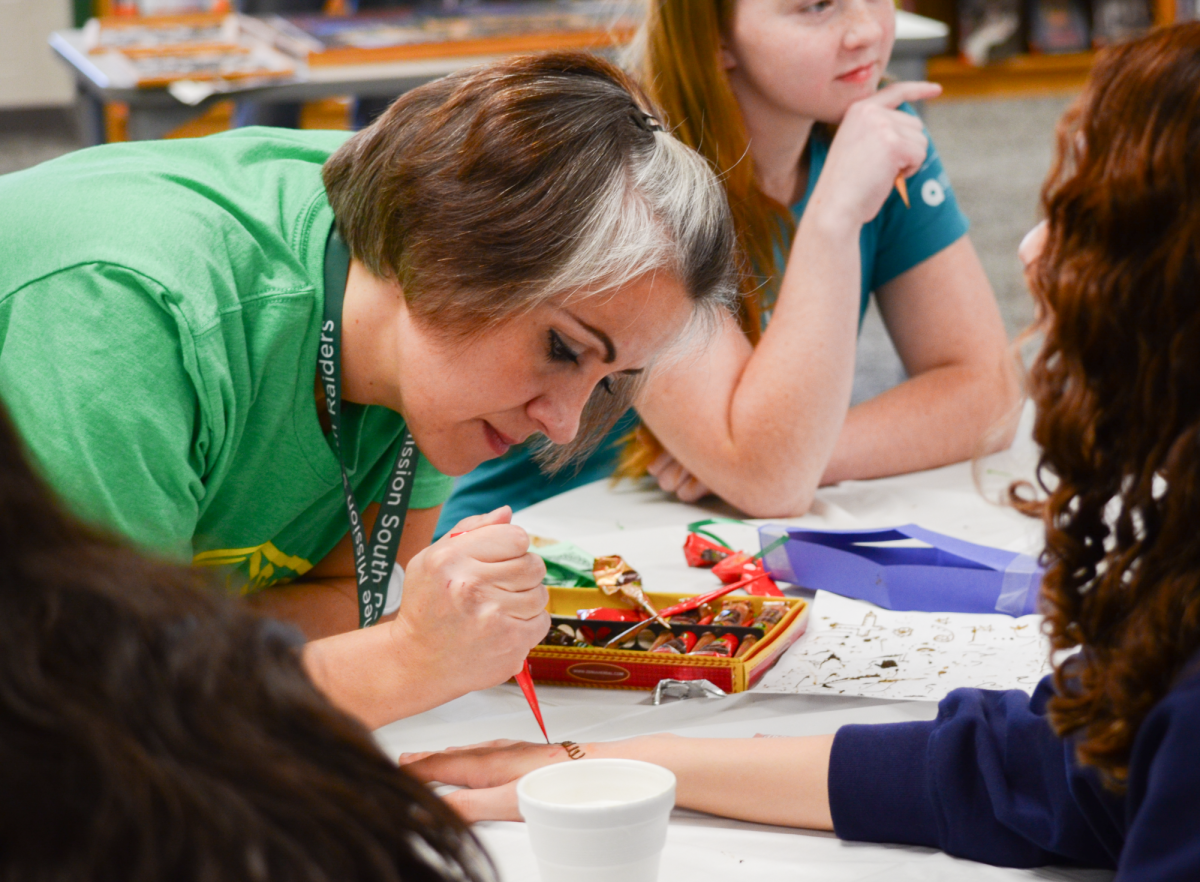

Bustling with people, students made their way through the library from table to table throughout the day on Nov. 10, bartering with vendors for henna, hummus and pita, and other goods. The arabic festival, an all day event put on by the Arabic classes and Arabic Honors Society aimed at sharing Arab culture to all, was in full swing.
“We were trying to spread Arab culture through a bunch of fun booths that demonstrate each kind of component of whatever our theme is,” junior Heba Boullaouz said. “This year we had the Souk theme, which is a market. We had a spice booth, tea or clothes, a sewing shop, fun little booths to demonstrate each.”
The Arabic festival provides a way to share Arab culture with the student body. Along with the Souk theme for this year’s festival came bartering. Bartering is a big part of a souk, with prices often being negotiated between the merchant and consumer in the market. Students who attended were given money in the form of dinars–the currency of several Arab nations such as Iraq–and were encouraged to barter for the goods provided at each of the themed booths.
“Everybody who came got five dinars to use to buy goods and services,” senior Eden Wagner said. “We had coffee and food that they could buy, and then also at each station a table was set up, like how a stand would be set up at a market. We had a spice table which was meant to reflect a spice stand. There was an authentic Arab items table which was supposed to represent textiles and carpets and handcrafted items, things like that.”
Behind the scenes, the Arabic festival has many factors that go into making it possible. Arabic students were given tasks such as helping Arabic teacher Annie Hasan–known to Arabic students as Usatha–unpack the items used in the festival and request donations of food or money from local Arab businesses to support the festival. Meanwhile, Hasan acquired a grant to cover some expenses of the festival.
“Our teacher is the one who is behind most of the work,” junior Shaefer Spizman said. “but also the students work behind the scenes too, to make sure there’s funding and all sorts of stuff for the festival. Then, when the actual day of the festival rolls around, it’s the students who actually put it on. We went to a couple different businesses and restaurants to get some donations for the festival, the students created the decorations for the festival and made sure that they were prepared.”
With all the effort put into the festival from Arabic students and Hasan, the festival gave students a chance to share knowledge about Arab culture to the rest of the student body in an interactive manner. All the preparation came together for the festival, with significant student engagement in the booths, specifically around the henna and cafe areas.
“I thought it was very interesting how it was set up as a market,” sophomore Liam Taylor said. “We exchanged dinars and it was fun how we could bargain and stuff. They did their best to make it authentic and teach us about Arabic culture.”